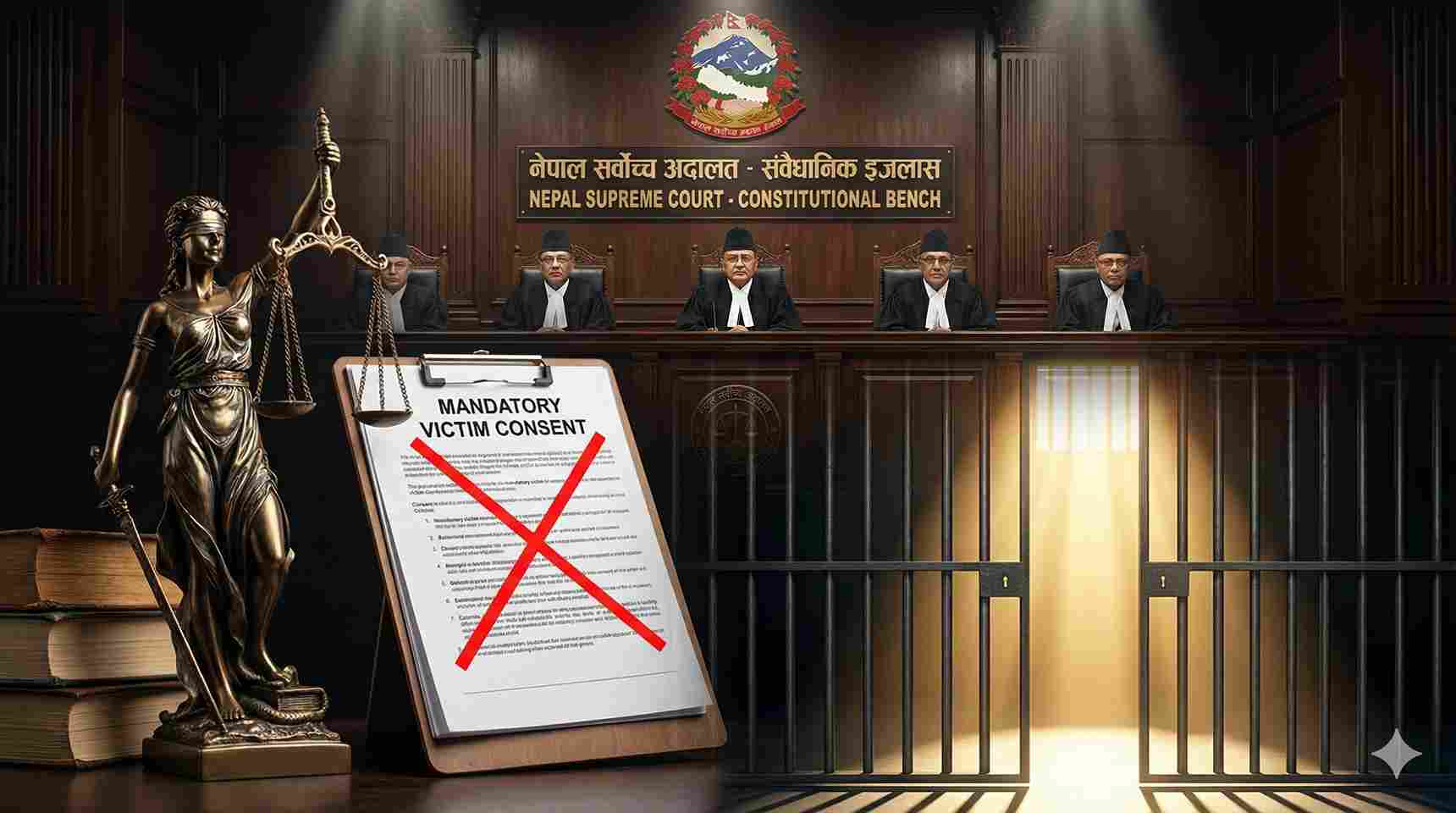
The Supreme Court of Nepal declared the mandatory consent provisions of the Criminal Offense (Sentence Remission) Rules, 2019, to be unconstitutional, but it protects the right to be heard of victims, not a right to decide.
- Case Overview and Parties
Case Number: 081-WF-0007
Petitioners: Rajan Majhi, Til Bahadur Malla Thakuri, Mahendra Pasi, and Laxman Gurung (currently serving sentences at Nakkhu Jail).
Respondents: Government of Nepal, Office of the Prime Minister and Council of Ministers, Ministry of Home Affairs, Department of Prison Management, and Prison Office Lalitpur.
Bench: Extended Full Bench (Brihat Purna Ijalas) comprising Hon. Justices Dr. Nahakul Subedi, Sharanga Subedi, Mahesh Sharma Paudel, Tek Prasad Dhungana, and Sunil Kumar Pokharel .
Decision Date: 2082/03/10 (June 24, 2025).
- Background and Procedural History
The petitioners were serving life sentences (20 years) for serious crimes, including homicide and robbery. They approached the court seeking a writ petition of habeas corpus and mandamus. Their primary grievance was against the Third Amendment (2081) of the Criminal Offense (Sentence Reduction) Rules, 2076, which introduced a mandatory requirement for victim consent to be eligible for sentence remission.
The petitioners argued that they had already served more than 40-50% of their sentences and were eligible for release under the Prison Rules, 2020. They contended that the new amendment, requiring victim consent, was being applied retrospectively, thereby infringing upon their rights and legitimate expectations.
The case was initially heard by a Division Bench, then referred to a Full Bench, and finally to this Extended Full Bench due to conflicting precedents and the serious constitutional questions involved regarding Article 276 (Clemency) and Article 21 (Victim Rights).
- Key Legal Issues Identified by the Court
The Court formulated five primary issues for resolution:
Clemency vs. Remission: What are the conceptual differences between “Pardon/Clemency” under Article 276 of the Constitution and “Sentence Reduction” under Section 37 of the Sentencing Act?.
Mandatory Victim Consent: Is the consent or agreement of the victim mandatory for granting sentence remission or clemency?.
Constitutional Validity: Is the requirement for mandatory victim consent in the 2081 amendment consistent with the Constitution and the Victim Protection Act, 2075? .
Retrospective Application: Can these new restrictive rules be applied to inmates who committed crimes or were sentenced before the rules were enacted?.
Relief: Should the petitioners be released via habeas corpus?.
- The Court’s Analysis and Jurisprudence
- Distinguishing Clemency from Remission
The Court provided a profound analysis of the state’s power to forgive or reduce sentences.
Constitutional Clemency (Article 276): This is a sovereign prerogative of the President to pardon, suspend, or commute sentences. The Court noted that while this was once an absolute “royal prerogative,” the 2072 Constitution limits it to being exercised “in accordance with the law” . It is often used for humanitarian, diplomatic, or political reasons, such as during national holidays or for elderly/ill prisoners.
Statutory Remission (Section 37 of the Sentencing Act): This is a rehabilitative tool. It is based on a prisoner’s behavior (good conduct) and the completion of a specific portion of the sentence (currently 50%).
The Ruling: The Court held that these two are distinct. Remission is an administrative/legal process that should be finalized by the Council of Ministers. The practice of sending all remission lists to the President for approval is legally unnecessary and confuses the two powers.
- Victim Rights vs. Executive Authority
The most controversial aspect of the case was the “Mandatory Victim Consent” rule.
Victim’s Role: Under Article 21, victims have the right to justice, compensation, and social rehabilitation. However, the Court ruled that “Justice” does not mean the victim has a veto over the state’s executive functions.
Privatization of Justice: The Court warned that making victim consent mandatory effectively “privatizes” the state’s power to punish. It creates a risk of “Blood Money” or “Blackmailing”, where a wealthy convict could buy a victim’s consent, or a victim could extort the convict’s family.
The Ruling: Mandatory consent is Unconstitutional. The Court struck down the specific provisions in the 2081 amendment that required written consent from the victim for sentence reduction. Instead, the Court established a “Right to be Heard” (Opinion/ धारणा), not a “Right to Decide”.
- The Principle of Non-Retrospectivity
Following the principle of Ex Post Facto laws (Article 20(4)), the Court held that a person cannot be given a punishment heavier than what was prescribed at the time of the offense.
The Ruling: If a new rule makes sentence reduction harder (e.g., increasing the required time served from 40% to 50% or adding new conditions like victim consent), it cannot be applied to those who committed the crime under the previous, more lenient regime. The Court directed the government to process the petitioners’ cases based on the Prison Rules, 2020 (if applicable).
- Final Orders and Directives (Mandamus)
The Court issued a series of binding directives to the Government of Nepal:
Legal Reform: Amend the rules to ensure that Sentence Remission (Section 37) is finalized by the Council of Ministers and is not sent to the President, keeping it separate from Constitutional Clemency.
Objective Evaluation: Prisons must conduct mandatory bi-annual (every 6 months) assessments of every prisoner’s conduct. Remission should only be granted based on these objective records, not on administrative whim.
Institutionalizing Victim Opinion: Before granting remission or clemency, the Ministry of Home Affairs must send the list of candidates to the Office of the Attorney General. The OAG must then publish this list on its website and provide a platform for victims or the public to submit their opinions or objections.
Declare null and void: The requirement of mandatory victim consent for sentence remission under Rule 5(1)(gha1) and Schedule 2Ka of the Criminal Offence (Sentence Remission) Rules, 2019 (Third Amendment, 2024) is inconsistent with Article 21 of the Constitution and the Crime Victim Protection Act, 2018, as victim rights do not include decisive control over the State’s remission powers.
Prospective Overruling: The Court explicitly overruled its previous stance in the Bharti Sherpa case regarding mandatory consent, stating that this new interpretation applies from today onwards.